A reD HooD · a book about late-diagnosed ADHD in women
You know what’s wrong. This book is about why it’s happening and what now.
It starts with the video that kept you up at night, and it walks you through the 2 a.m. reading, the diagnosis and the drawer full of planners. Then it goes where one more symptom list can’t.
- in your inbox right after checkout
- no subscription
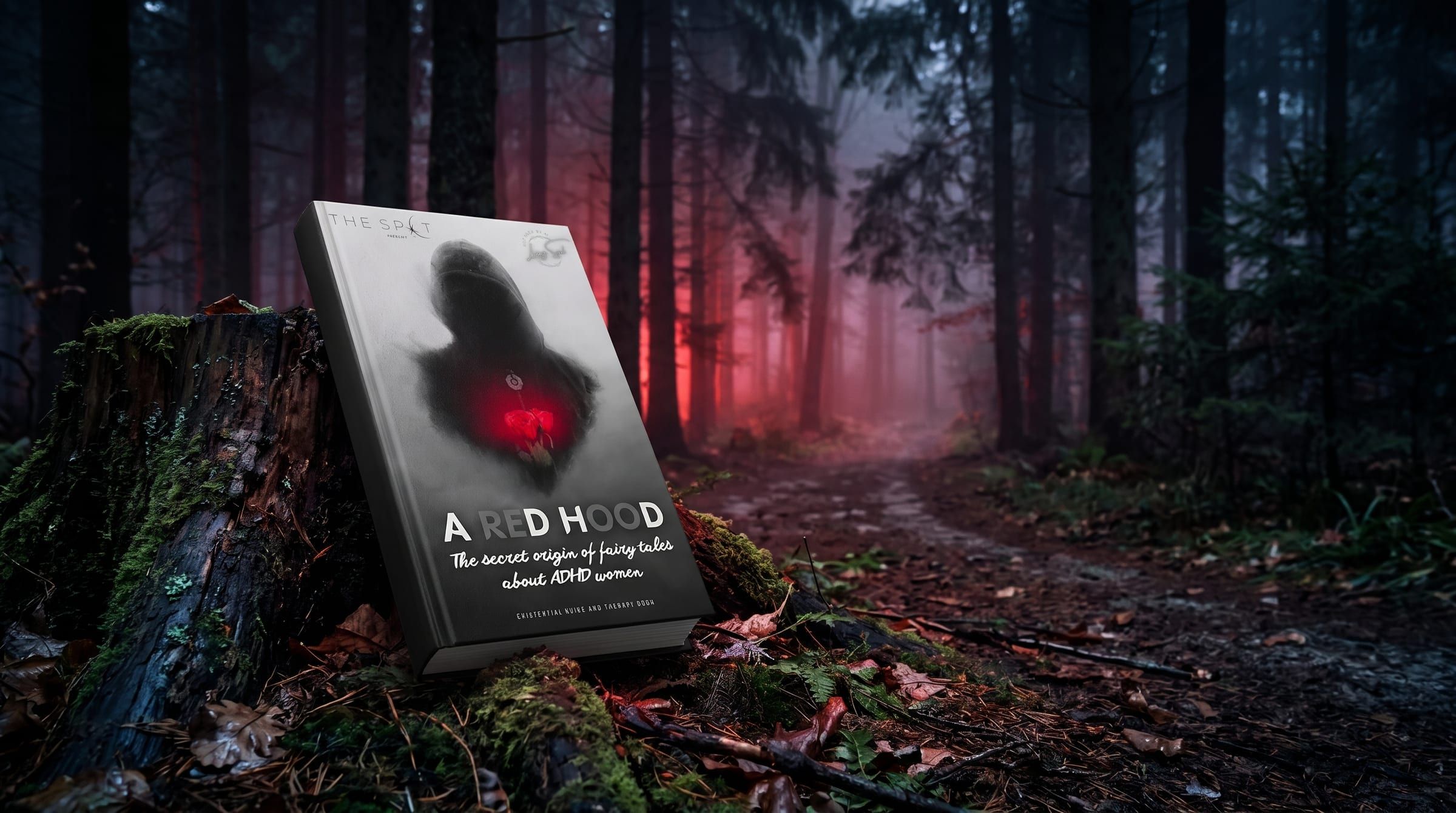
PDF + EPUB
The sentences we say
Lilli, who guides you through the book, collected them from the posts of more than 8,000 women. They came up so often she stopped counting.
The book has fifteen of them. Each one is a symptom, just said the way we say it at home.
“Sorry it took me so long to reply!!”
I saw the message right away. I had the answer finished in my head. Typing it and hitting send took eleven days, and every day it got harder.
“Yeah, I was just about to do that.”
And it’s true. I’ve been about to do it since Tuesday.
“I put it somewhere smart so I wouldn’t lose it.”
A passport, a warranty card, a present bought in October. The smart place is remembered only by the woman who came up with it back then.
“What? … Oh, yeah, I know.”
I heard it the first time. It just arrived a second late.
“Existing is exhausting.”
I don’t mean anything dramatic by it. I mean Tuesday.
“Sorry, my train of thought derailed.”
More accurate than “I forgot.” Forgetting is quiet. This you can hear.
The book has fifteen of them. Each one is a symptom, just said the way we say it at home.
The spiral you may already know
The author read the stories of 8,000 women and expected 8,000 different ones. They differed in everything lives differ in: age, country, work, kids. And yet the same order of events kept coming back. When he drew it, it came out as a spiral.
Encounter. A video, an article, something a friend says. “That’s me.”
Self-diagnosis. Nights of reading, the first doctors, the first doubt about whether you’re making it up.
Paradoxes. Smart, and yet it doesn’t work. Good, but. Good at twenty things, at home good at none.
Manifestations. Everything gets a name. Then those names start commenting on your every move.
Loss of identity. You take off the mask, and underneath you don’t find what you were promised.
Grieving the child. Counting what could have been if someone had asked sooner.
Questions. “So now what?”
Every stop gives you a real answer, and relief along with it. That relief is why you keep going. And every answer also narrows you a little.
At the start you’re a woman who has trouble with something. At the end you’re a list of troubles looking for a woman.
All seven stops answer a single question: what is wrong with me. The internet answers it a thousand ways and adds another every day. At the bottom of the spiral, a woman gets a planner.
Find out where you are on the spiralThree questions, four phases
What’s wrong with me, why is this happening to me, and what now. You probably have the first answer already, from a doctor or from your phone at two in the morning. The book still starts there, because you need it whole and in one place. Most of the pages, though, belong to the other two.
Phase I · The Spiral
what’s wrong with me?
Lilli is thirty-six. It started with one reel on a Tuesday night on the couch. Chapter by chapter she goes down the spiral, and in the end she sits down with her notebook: 106 manifestations, the 20 questions no doctor asked her, and the 15 sentences we say.
Phase II · The Dream
why this is happening?
Lilli falls asleep over the notebook and in her dream she’s twelve. In the woods behind the house, the wolf from the fairy tale is waiting. Then come chapters that seem to have nothing to do with ADHD: the forager’s mind, the spiral and the straight line, the moon in the body, the forest and the fence. After them, you see your ADHD differently.
Phase III · S.O.W.L.
what now?
Nine evenings with the Wolf, one subject each. No daily schedule. You get a principle and an experiment you can try that same night.
Phase IV · Under the Mask
who am I?
Jung, the Shadow, the inner critic and the old alchemical Work that turns lead into gold. This phase doesn’t ask how to get rid of ADHD. It looks for the way out of masking, toward who you are underneath.
One promise: by the end, you’ll answer all three questions yourself, in your own words.
From Phase II
“Listen to me carefully. I didn’t eat anyone. And you… your mistake wasn’t straying from the path. Your mistake, the only mistake the girl in the story ever made, was going back to it.”
You know Little Red Riding Hood in the version the huntsman told. The girl in red strayed from the path because she saw flowers and heard birds, and the story punished her for it. That’s where the book gets its name. In Phase III, Lilli leaves the path again. This time on purpose.
Nine evenings with the Wolf
Lilli goes back to the woods with one sentence: “I know why. I don’t know how.” The Wolf answers her over nine evenings. Each evening has four steps, named after his neighbor, who sees in the dark where everyone else walks into trees. S.O.W.L. reads as owl.
- Time
- Attention
- The Body
- Intuition
- Memory
- Élan Vital
- Emotions
- The Shadow
- Life
S – See
A story, a year, a place. And the moment you say: “I know this. This is the feeling I never had a word for.”
O – Obtain
Two voices side by side. The old one, the voice the world uses on you, and after thirty years the one you use on yourself, and a new view of what is really happening inside you. “You’ve spent your whole life reading the manual for a microwave, and you’re a convection oven.”
W – Weapon
No “get up at six and make a list.” A sword and the principle of the cut. You’ll bend the grip to fit your own hand.
L – Live
One experiment you do right away, and one line for your journal.
There’s no planner inside. But grab a pencil.
Where are you on the spiral?
Ten questions, three minutes. Your result shows which stop you’re at and what the book gives you there. Your answers stay in your browser.
Take the quizWhat’s in the book
- 186 books
- 400 studies
- 8,000+ women
- 106 manifestations
That’s what the author went through before he started writing. The data became Lilli’s notebook. For why and what now, he looked in books that aren’t about ADHD.
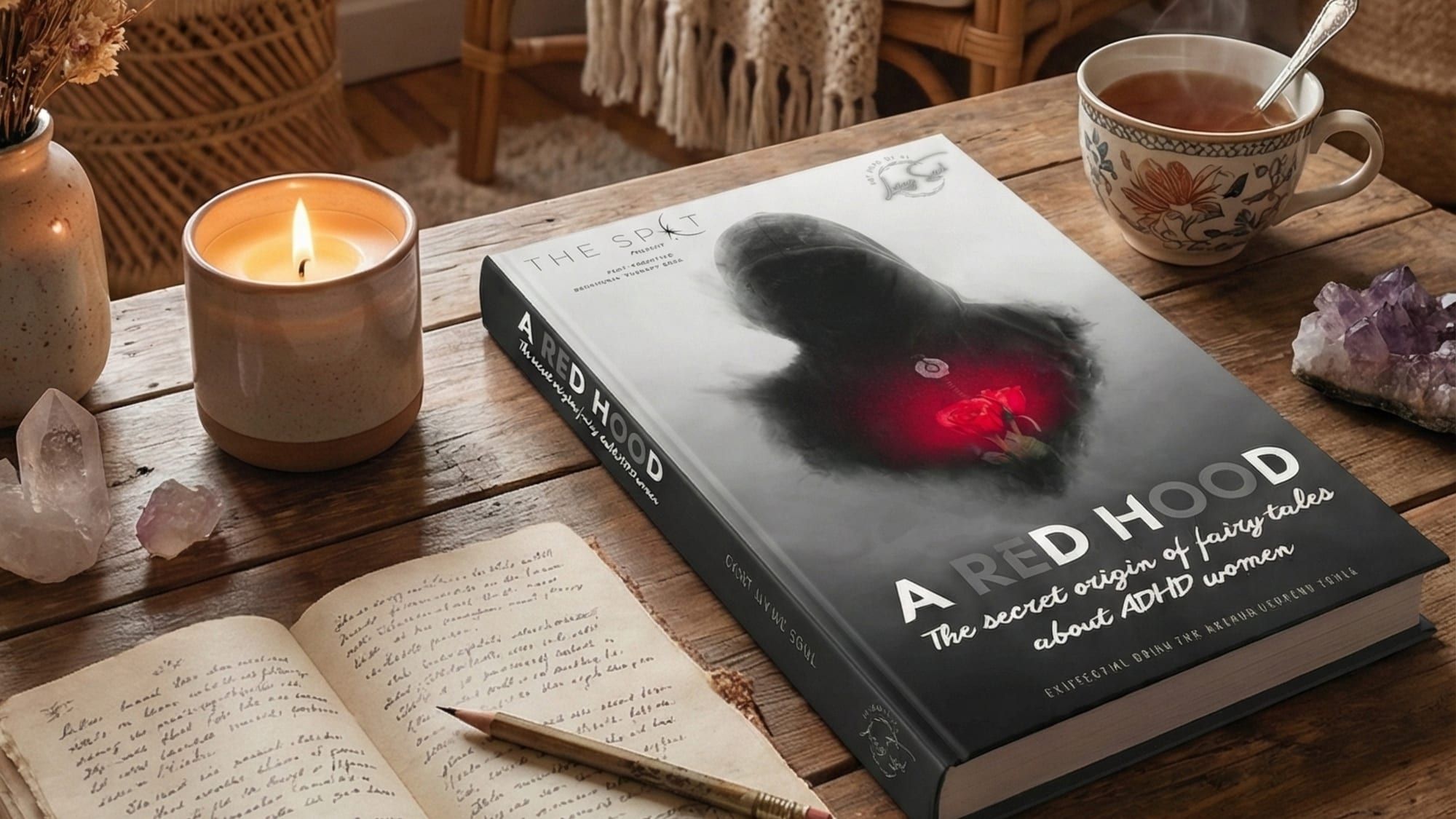
- Lilli’s story in nine chapters, from the first video to the question “Who am I without the mask?”
- A notebook of 106 manifestations of ADHD in women. 69 weigh on you (N codes), 37 give something back (E codes). The index at the back lets you return to any of them.
- The 20 questions no one asked you, the 15 sentences we say, and 12 paradoxes
- Sixteen chapters in Phase II on why this is happening to you
- Nine evenings of S.O.W.L., each with an experiment and a line for your journal
- Jung’s map of the psyche, the Shadow, the Animus, archetypes and the alchemical Work in Phase IV
- A glossary and a bibliography
Who this book is for
It’s for you if…
- you only suspect ADHD and keep asking yourself whether you’re making it up
- your diagnosis is new and you’re reading until 2 a.m.
- you’ve had the diagnosis for years and still don’t know why
- you own more planners than systems that lasted
- you want to understand yourself, not read one more symptom list
Probably not if…
- you’re looking for a diagnostic test. The book doesn’t diagnose and won’t replace an evaluation.
- you want arguments for or against medication. The book stays out of it on purpose.
- you’re expecting a 30-day program and a daily schedule
A man wrote it. Here’s why.
For half a year we wrote to each other and spent hours on video calls. Then we met. I opened the door, and there stood a woman who looked exactly like the one on the screen. I didn’t know her.
I’ve had ADHD my whole life too. But when I was a child, no one told me it was an illness, so I took it as a trait. I work in data, and when I don’t understand something, I start digging. I went through 186 books, 400 studies and the posts of more than eight thousand women. That data became Lilli’s notebook. The answers to why and what now, though, I found elsewhere, in books that aren’t about ADHD: in Bergson, in Jung, in the alchemists.
I wanted to understand one woman. I had no idea it would become a book.
Martin Krajíček
The whole storyThe book is published by TheSpot. TheSpotADHD.com is becoming a place for women with ADHD, home to the S.O.W.L. course and the book’s workbook module.

$9.99
A reD HooD, the ebook
A reD HooD
The Secret Origin of Fairy Tales About ADHD Women
Martin Krajíček · published by TheSpot
$9.99final price
- PDF in A5 format, made for reading on your phone
- EPUB for e‑readers and reading apps
- a download link in your inbox right after checkout
- the S.O.W.L. workbook module on TheSpotADHD.com, free
Pay by card, Apple Pay or Google Pay through Stripe. Your receipt comes by email.
This is digital content delivered immediately, so the 14-day right of withdrawal does not apply once you confirm at checkout. If the ebook doesn’t arrive or won’t open, write to hello@aredhood.com.
Questions
I don’t have a diagnosis. Is this book for me?
Yes. Phase I starts with a woman who didn’t have one either, just a video at 2 a.m. and the question of whether she was making it up. The book doesn’t diagnose and doesn’t replace a diagnosis. If you’re thinking about an evaluation, it can help you sort your thoughts, but it won’t save you the trip to the doctor.
Is the book against medication?
It’s neither for nor against. Medication helped some of the women in the book; others stopped taking it. The book deals with what medication doesn’t answer: why this is happening to you and who you are under the mask. If you take medication, don’t change anything without talking to your doctor.
Why is a man writing about women with ADHD?
The voice of the book belongs to women. Lilli is pieced together from what more than 8,000 women wrote about themselves, and the quotes are theirs, shortened and unnamed. The author steps in only a few times and says plainly who he is: a man who has had ADHD his whole life and fell into the Phase I spiral himself while trying to understand one woman.
Is this therapy?
No. It’s an existential guide. It offers a different way of seeing and tools you adapt yourself. It doesn’t replace medical or psychological care.
Is there a planner or a 30-day program inside?
No. You probably have enough planners, and the book knows it. Phase III gives you principles and experiments, not a daily schedule.
I don’t finish long books. Will I get through this one?
It was written for readers who know that feeling. The chapters are short, the first two phases are a story, and every evening in Phase III has four steps. You don’t have to read the notebook of manifestations front to back. Read it like a menu: look for what’s yours and skip the rest.
How do I get the ebook, and what can I read it on?
Right after checkout you’ll get an email with a download link. The A5 PDF reads well on a phone. The EPUB opens in Apple Books, Kobo, Google Play Books and most e‑readers, and on Kindle via Send to Kindle. The link is valid for 7 days.
What is TheSpot?
The publisher of the book and a platform for women with ADHD at TheSpotADHD.com. That’s where you’ll find the S.O.W.L. course and the book’s workbook module.
Something went wrong with payment or download.
Email hello@aredhood.com with your Stripe receipt number and we’ll sort it out.
“You will never see a wolf in the circus.”
The book doesn’t end with a planner. It ends with you answering the three questions yourself.